
 ™
Lotz House Museum
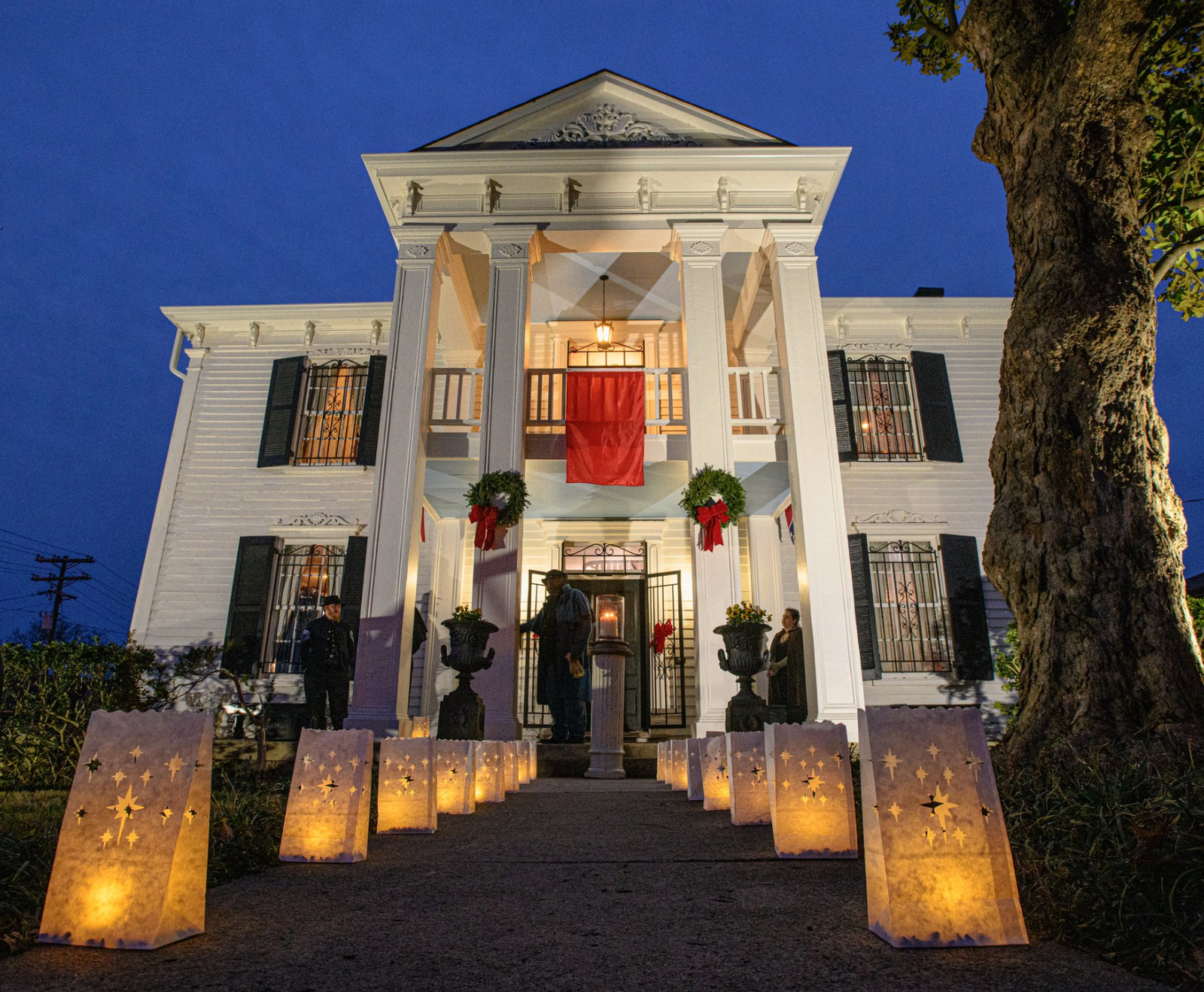
The house, which has been on the National Historic Register since 1976 is located in the heart of downtown historic Franklin, Tennessee at “ground zero” of the Battle of Franklin which was a pivotal battle in the American Civil War.
On the night of November 29, 1864 approximately 25,000 Northern soldiers retreated from Spring Hill, Tennessee into Franklin, Tennessee. These troops quickly dug protective trenches south of the Lotz House and waited to see if they would be attacked by the Confederate army.
When the Lotz family awakened on the morning of November 30, in effect the Federal Line had been established in their front yard. Mr. Lotz, fearing that his family, his wife Margaretha, his sons Paul and Augustus and daughter Matilda would not survive the battle in their “wooden house,” sought refuge 110 steps across the street in the brick basement of The Carter House. For 17 hours, while the battle raged all around them, the Lotz along with 20 other people remained safe and survived.
When they exited the basement the next morning, they were horrified to see bodies of dead soldiers six feet deep between The Carter House and their home across the street. Indeed, historians describe the fighting that took place at the Battle of Franklin and in the Lotz front yard “some of the most severe hand to hand fighting during the four year long war.” When the dust settled the body count would be horrific. Ten thousand Americans had been killed, wounded or missing. The Lotz House served as a hospital for the wounded soldiers on both sides until the following summer.
To this day, one can step into the Lotz House and see numerous blood stains in all of the rooms. The house itself suffered severe battle damage, but as the structure served as Lotz’ “show house,” he was quick to make repairs; however, some of the battle scars remain. During the battle a solid shot cannon ball crashed through the roof, smashing into the floor of an upstairs bedroom and down to the first floor. The large repaired patch made by Mr. Lotz remains. On the first floor, where the cannon ball finally came to rest, the path of the hot lead ball into the home is visible.
Know before you go
General opening hours. Events can run outside them.
More about Lotz House Museum
Advance Reservations
Advance reservations are required for the all specialty tours. Please call (615)-790-7190 or email info@lotzhouse.com to book tickets.
Johann Albert Lotz
In 1855, German immigrant Johann Albert Lotz, purchased 5 acres of land from Fountain Branch Carter. Lotz, a classically trained master woodworker from Saxony, completed his home three years later. By trade, Mr. Lotz was a master carpenter and piano maker who also repaired guitars and violins. His home, served as his “show house” to demonstrate his carpentry work to potential clients interested in hiring him for his services.
The three fireplace mantles demonstrated his range from simple to very complex designs, all of them are carved from different kinds of wood. In addition, the home has an impressive free floating, black walnut wrap around hand rail and cantilevered staircase. To accomplish this engineering feat in the mid-19th century is truly remarkable. What’s more, the newel post at the bottom of the staircase is actually an inverted leg of one Mr. Lotz's pianos. The outside of the home is a testament to Mr. Lotz talent as the hand carved acorn finials; millwork and cartouches were constructed by Lotz.
Matilda Lotz
Matilda Lotz was the daughter of German immigrant Johann Lotz who built the Lotz House in 1858. As the Lotz House was wooden, Mr. Carter from across the street, sent a message to Mr. Lotz and his family at the time of the Battle of Franklin, inviting them to come over to The brick Carter House in great haste. Both families headed to the basement of the Carter farmhouse to escape the bullets and cannon fire of the enemy. This generous invitation was eagerly accepted by the Lotz family. Matilda Lotz was a small girl who had turn six years old November 29, 1864, the day before the Battle of Franklin.
Since birth, Matilda had scribbled line drawings in the dirt of household animals and on rare occasions when they were presented a scrap of paper, she would take a small bit of cooled coal from a fireplace, and draw childish figures. It is reported that only once did she attempt to express her artistic ability on a vacant wall, but the discipline that followed was a life learned lesson. Today, an individual can only imagine the dire impact of the war on such a young and sheltered life. Upon awakening on December 1, 1864 with great and blessed joy of being alive on her birthday and then - the next day -coming up and out of the Carter basement into the overwhelming hurt and horror of thousands of dead bodies of soldiers lying one on top of another.
The Lotz family was never able to recover their struggling life in Franklin, Tennessee following the war. In autumn of 1869, the family was forced to leave the home in which Mr. Lotz took such pride.
They migrated west first to Memphis, Tennessee for a brief time and then via covered wagon all the way to California. In 1870 the Lotz family settled in San Jose, California. There Matilda received her first true art lessons from her older brother Paul and other artists employed locally by Wrights Photography Gallery. In 1874, she began a six-year course of study under Virgil Williams at the school of design in San Francisco. While attending that school she won several gold medals and graduated with highest honors.
Matilda was also a pupil of William Keith and in the 1880’s to further her art study in Paris, France under Felix Barrias and the famous animal painter Van Marcke. While in Paris she received an honorable mention for her work exhibited at the Paris Salon and was awarded two gold medals by the Paris Academy of Painting (the first woman ever to be honored by the Academy). She traveled extensively in Europe and Egypt, as a single un-chaperoned woman, something which for the times a woman simply did not do. Despite her work load, she was frequently commissioned to paint portraits of royal families throughout Europe. Matilda found time to return to visit her family in California.
While at home she was commissioned to paint the portrait of George Hearst, father of William Randolph Hearst. Matilda’s painting of George Hearst hangs today in The Hearst Castle. Matilda was also retained to paint the portrait of former California Governor Leland Stanford, the founder of Stanford University. That portrait remains on display at Stanford University. After leading a unique and noteworthy artistic life, she died in Tata, Hungary on Feb. 21, 1923.
Today, Matilda Lotz is recognized as one of California’s premiere early female artists and her work is highly prized and sought after both in the US as well as throughout Europe where she lived most of her adult life. The Lotz House has several of Matilda’s original oil paintings on permanent display including “Sheep at Rest,” “Donkey,” “Wolf,” “Harry Wilkes,” “The Herd,” “Black Sheep” and “The Work Horse.”
Thomas Y. Cartwright Tours
Thomas Y. Cartwright, one of the nation’s leading authorities on the Battle of Franklin, offers personalized “Battlefield Tours” from the Lotz House. You’ve seen him on the History Channel, A&E and the Discovery Channel, and now he can be your personal tour guide as you walk with him over the battlefield and hear the stories of some of the bravest men in history – the soldiers of the Battle of Franklin.
Cartwright, well-known internationally for his knowledge and passion for the Civil War and the Battle of Franklin, will walk the battlefield in the steps of the soldiers and tell the gripping stories of the soldiers and their lifestyle.
Reservations are required for this walking tour.
Decorative & Fine Arts
While on the guided tour of the Lotz House you will learn about the history of many of the antiques and furnishings. You’ll see some of the most exquisite examples of John Henry Belter and Prudent Mallard furniture from the 1820’s – 1860’s. What’s more, you’ll also see several pieces of furniture made by Mr. Lotz himself. In each room you’ll view exceptional pieces of Old Paris Porcelain designed for a wide variety of use.
The Lotz House contains an extraordinary number of rare and scarce porcelain pieces including tea sets, Veilleuses and even a very rare Old Paris water or juice chiller. While you may be familiar with Audubon paintings and prints, you may not be aware that John James Audubon actually painted from birds he captured and stuffed to examine them in their more natural form.
You’ll see Audubon’s stuffed birds placed under their original glass dome. In fact, the former editor at large at The Magazine Antiques, said this about the Lotz House collection, “It is by far the finest private collection of American Victorian Furniture in the Southeast.”
AAA Tour Discount & Parking
AAA Members receive a 10% discount
Parking is FREE for all
Tours may be customized from 30 minutes – 1 hour


